
Low vision solutions, demonstrations, magnification and advice to suit you.


Digital magnifier high definition screen allows more flexible working distances that suits each individual compared with optical magnifiers set distances. They can feature large tactile buttons with magnification ranges from 1.7x to 12x, true colour and contrast enhancement modes.
The Mobilent LED is a folding pocket magnifier that offers high magnification (4X, 7X or 10X) in a compact size with added LED illumination. Its built-in case is designed to provide complete protection for the lens when not in use. The quick-release clasp on the lanyard allows the magnifier to be easily unhooked when needed. The Mobilent LED is ideal for near spotting tasks such as reading price tags, prescriptions, labels and more. Due to its compact size, it fits easily into a pocket or purse and is ideal for magnifying small print discretely.
We can help with simple and specialised optical and digital magnification, portable hands-free, occupational, and hobby magnifiers.
New digital magnifiers with a seamless zoom from 2-22X, allows for line scrolling, speech assistance, and the ability to write underneath and allowing to be connected to a monitor via HDMI for greater magnification (12-125x on a 1016mm TV). Digital magnifier high definition screen allows more flexible working distances that suit each individual compared with optical magnifier set distances.
They can feature large tactile buttons with magnification ranges from 1.7x to 12x, true colour and contrast enhancement modes. We can find the right visual aid for sewing, craft indeed any occupational or hobby requirement from simple to closed-circuit TV systems and Orcam systems.
The higher powers are multiplied by 4 giving dioptres to magnification. ie 4x is 16Dpt, 7x is 28Dpt. For the lower powers this is not the case.
Eschenbach, like most magnifier manufactures, use Commercial magnification for dioptre powers of 10dpt or less.
Commercial magnification is dioptre power divided by 4, Plus 1. Commercial magnification assumes that lower powers will be used binocularly and therefore there will be some accomodation or used in conjunction with a near add.
The ability to accommodate or a near add is the reason for the Plus 1. The actual powers are 1.7x is 2.5dpt, 2x is 2.5dpt and has convergence prisms, 2.5x is 5dpt 3x is 7.75dpt
Eschenbach low vision products
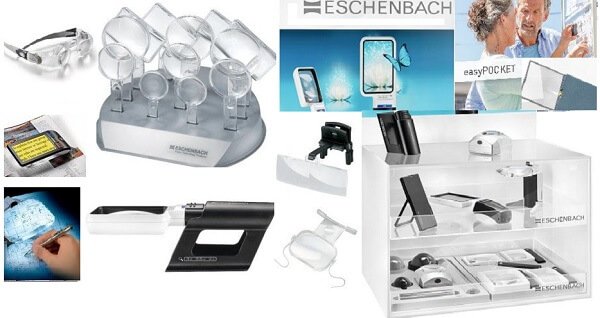
Eschenbach’s Mobilux LED 3.5X (model 15113) is the most sold magnifier in Australia has a base and can be used either horizontally or vertically. For the hobbyist, Daylight LED magnifiers can be invaluable as are compact telescope and binoculars for viewing afar.
Electronic and CCTV systems enable large screens, numerous contrast options, dynamic line scrolling, and can deliver better results than simple magnification systems even Phone Apps these days such as VISOR.


Eschenbach produce four exceptional portable digital magnifiers. The Mobilux Digital Touch HD operation is via touch screen so it is intuitive to use and offers 1.9X to 12X magnification. It can also be plugged into a monitor to convert it into a screen reader resulting in higher magnification if desired. The Mobilux Touch offers 5 viewing modes as well as reading lines/blinds plus a photo storage function. Weighing only 230 grams.
Smartlux Digital Features up to 12X magnification on a 5 inch, non reflective screen, the HD camera provides true colour, sharp images even at high magnifications. The Smartlux has a stand for comfortable reading or for writing underneath the device. Alternatively it can be easily handheld weighing only 240 grams. The Smartlux can be plugged into a screen via HDMI cable to be used as a video desktop magnifier so it is very versatile for use at home, in the workplace or on the go.

Eschenbach’s Visolux DIGITAL HD is a 7-inch intuitive and practical digital magnifier, with the best image quality in the 7 inch category. Weighing only 460 grams.With up to 22X magnification. Featuring dynamic line scrolling (moving the reading area horizontally across the screen without moving the reading material) and reading lines or blinds. The unit can be used as a screen reader when plugged into a TV monitor or projector allowing for much higher magnification to be achieved.
The Visolux Digital XL FHD has 12 inch screen and is our most popular digital magnifier. It gives the user a choice of a touch screen or tactile buttons.
It also has the added benefit of both horizontal and vertical dynamic line scrolling and speech output for the menu. You can write under the device and it can be plugged into an external screen to be used as a video desktop magnifier. It can also be plugged into a separate video camera to be used for distance viewing such as a whiteboard at work or school. Magnification range of the unit is 2X to 22X but it can also be connected to a TV, monitor or projector and thus achieve magnification of up to 125X. Weighing only 1kg, the Visolux XL bridges the gap between a portable device and a CCTV desktop system, negating the need for both. It can be plugged into an external camera for use in situations such as reading a whiteboard at a distance. The high contrast, high resolution camera, provides crisp image quality at any magnification. Other features include reading lines or reading blinds, SD card for storing images taken on the device, a spoken menu in 4 languages and 14 contrast enhanced false colour modes. The Visloux Digital XL has a lithium-polymer rechargeable battery for up to 2.5 hours of operation with a short recharging time and an auto shut off.
The Visolux XL is ideal for age-related or degenerative conditions as the device can grow with the user. Increasing the magnification and altering contrast settings means the patient can continue to use the same, familiar device as their vision deteriorates. As with all of our digital magnifiers, the Visolux Digital XL is available to loan for trialing prior to purchase.

We have a range of daylight illumination lamps that uses the colour temperature of 6000K for all of its lights.
The colour temperature of daylight is usually considered to be in the range of 5500K – 6500K (Kelvin)
There are a few new Daylight lamps such as the Electra and Tricolor which have 3 colour temperatures, but they always have one of the colour temperatures as 6000K.
Telescopes, Bioptics for driving

Galilean telescopes are smaller and lightweight offering about 5 degrees of the field at 4x. Normally 1.7x and 2.2x are used

Keplerian telescopes are longer and heavier offering about 12 degrees of the field at 4x. Normally 3x,4x,5x, and 6x are used
Driving with Bioptics
Bioptic telescopes can help eligible visually impaired individuals sometimes obtain a driver’s license and be safer drivers.
The bioptic telescope allows them to see the target sooner, giving the driver more time to react. In practice, the telescope increases the individual’s ability to see further forward by a factor of the power of the device. For example, a 3x telescope will allow the user to see a sign at 18 meters through their bioptic, while they would only be able to see it at 6 meters with their normal vision.
Drivers using bioptics normally see through their regular glasses but utilise the telescope function for short periods of time in a similar fashion to using rear and side-view mirrors.
Ocutech VES Falcon Bioptic Telescope
The Ocutech VES Falcon Bioptic Telescope is the world’s only autofocusing bioptic for the visually impaired.

4x, 12.5-degree Keplerian optics
Focuses from 13” to infinity
Weighs just 3.2 ounces (90 grams)
Interchangeable for right or left eye
Simple eyepiece focusing for prescriptions to +/-8D
Operates 8 hours using its separate rechargeable battery
Natural hands-free magnified vision
Enables user for an improved engagement at work or social settings and for personal tasks
ORCAM TECHNOLOGY
OrCam technology responds to hand gestures and allows
Reading of Text
Facial Recognition and identification of shopping products
Portable and magnetically mounts onto eyeglass frame.
Wireless technology and not require an internet connection.
More than 20 voice-activated commands available
Bluetooth connectivity and barcode recognition.
Esight for legally blind
A wearable electronic aid that assists the legally blind to actually see in a bioptic manner, not drive though. Most other devices using VR/AR headsets completely immerse the wearer in that view, at the expense of peripheral awareness and mobility.
Esight is actually trying to improve the vision of people with some remaining vision from about 6/24 to 6/180 even to 6/240. The Seeing AI app attempts to read out text and describe scenes ie by pointing a suitable smartphone to enable descriptions.
Electronic mobility aids / Orientation devices: Act by sending out ultrasonic beams and providing vibratory or auditory feedback to the user when it detects an obstacle.
GPS devices: Global Positioning System (GPS) with software can be operated through an accessible mobile phone (with speech software) or can be incorporated into a white cane.
CHOOSING THE CORRECT BINOCULAR

The right binocular for any use can be found. From a simple monocular that fits in your pocket to twilight binoculars.
The quality of the optics, the types of coatings applied to the lenses, the housing material all vary widely akin to the case in spectacles.
All binoculars are identified by a set of numbers, such as 10×42 and 7×20, which refer to their magnification and objective lens diameter, respectively. Using 10×42 as an example, the 10x means that the binoculars have 10x magnification power, making the view through them appear 10 times closer than it appears to the naked eye.
READ MORE ON BINOCULAR TECHNOLOGY
Binoculars (being more comfortable than a monocular) use lenses and prisms to produce a magnified view of distant objects or scenes.
Prisms are used to correct the orientation of the view horizontally and vertically whereas the human brain does this to a focused image.
The elements in the more compact roof prism are in line with one another unlike those offset from one another in Porro prisms.
Porro prism binoculars are typically more cost-effective to produce than roof prisms.
Binoculars from 7x to 10x power are the most commonly used. Tripods are used with higher magnifications or larger objectives as in cameras
The higher the magnification, the smaller the field of view.
Larger objectives though heavier allow more light to pass through them than smaller lenses, which means images will appear brighter, sharper, and clearer.
Zoom binoculars offer variable magnification with some loss in image brightness and sharpness. To see the exit pupil, hold the binocular away from your face and notice the small dots of light in the center of the eyepieces. Binoculars exit pupil diameter is determined by dividing the objective by the magnification: so a 10×42 binocular has a 4.2mm exit pupil diameter which is desirable as bigger than the average pupil. Manufacturers install eyecups on the eyepieces to place the user’s eyes at the proper distance from the eyepieces.
BAK4 Barium Crown glass is considered the best type of prism material though BK7 glass is arguably the most widely used material for binoculars.SK15 glass is also sometimes used. Lens coatings are thin films applied to lens surfaces to reduce glare and reflections, increase light transmission and contrast, and brighten colours. Coated lenses are the most basic and denote that at least one lens surface has at least one layer of coating on it. Multi-coating refers to multiple layers applied to each surface. Fully multi-coated means that all surfaces—inner and outer—of the lenses have multiple layers applied to them. This treatment offers the highest level of light transmission, clarity, contrast, and colour rendition. These coatings are engineered to be effective across a wide spectrum of wavelengths and provide the best performance. Prism Coatings may use standard reflective coatings, or dielectric coatings, which allow almost 100% of the light through the prism, resulting in brighter high-contrast images.
Phase-correcting coatings can be used in roof prisms. Most binoculars have the main focus wheel set on the bridge to move the two oculars symmetrically. Many binoculars have no weatherproofing, while some are waterproof and others are waterproof and fog proof by filling with inert gases to prevent fogging. The aluminum chassis are the most popular or the lighter magnesium or polycarbonate.
Some binoculars have even integrated compasses, cameras, infrared viewfinders.
Eyecups position the eye at the proper distance and are often with wraps around the eye socket to block stray light. Digiscoping is where adapters eg on phones which allow photos of the magnified view.
ROYAL BLIND SOCIETY AUSTRALIA
The Royal Society for the Blind (RSB) Australia provides services to Australians who have a severe vision impairment.
The UK Royal National Institute of Blind People is the UK equivalent and has been established since 1868.
World Braille Day 3 January is celebrated every year on Louis Braille’s birthday, the inventor of braille.
Australian $5, $10, and $50 notes now have a tactile feature to help meet the needs of the vision-impaired community.